Last reviewed November 19, 2026
What IPEDS is, and what it cannot replace
The federal government already maintains a comprehensive statistical record of U.S. colleges through IPEDS. It is essential for long-term trends, institutional finances, and broad coverage, but it moves on a slower federal schedule and leaves out key admissions details colleges publish in their Common Data Sets.
The federal baseline (and UNITID)
Run by the National Center for Education Statistics, IPEDS (the Integrated Postsecondary Education Data System) collects annual survey data from roughly 6,400 U.S. institutions that participate in federal financial aid. Every institution has a permanent numeric identifier called a UNITID (for example, 115409 for Harvey Mudd and 233921 for Virginia Tech), which is how we reliably match federal records to each school's published reports.
For official definitions and raw downloads, go to nces.ed.gov/ipeds. This guide explains how those federal tables appear on collegedata.fyi and where they differ from a college's Common Data Set.
How IPEDS data is structured
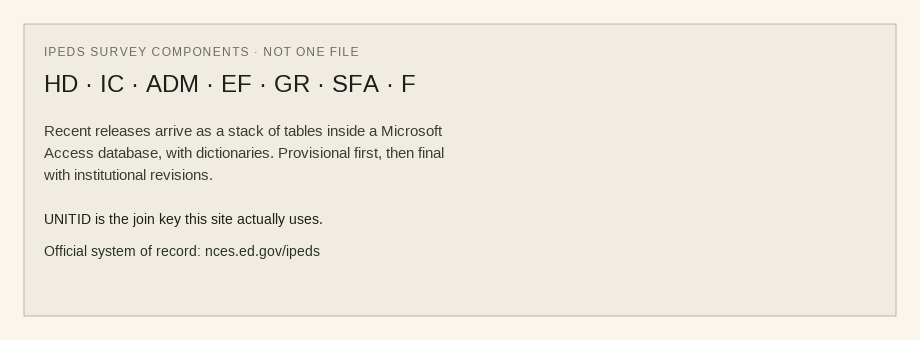
Instead of one annual document, IPEDS is organized into separate survey components: directory information (HD), institutional characteristics (IC), admissions (ADM), fall enrollment (EF), graduation rates (GR), student financial aid (SFA), and finance (F). NCES publishes provisional files first (after quality checks and imputations for missing responses), followed later by revised final files distributed as Microsoft Access databases and codebooks.
How IPEDS appears on a school page
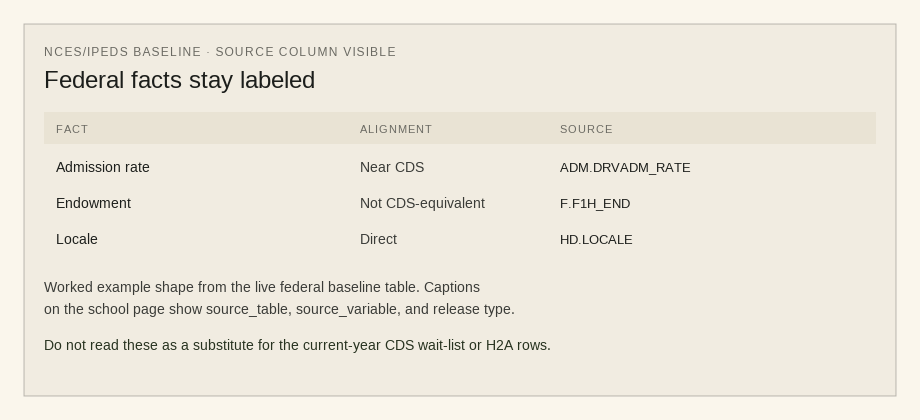
On every school page, the federal baseline table lists the exact IPEDS table, variable name, release status (provisional or final), and how closely the federal definition aligns with the Common Data Set:
| Fact | Alignment | Why it matters |
|---|---|---|
| Admission rate | Near CDS | ADM totals track C1 closely, though definitions of student population, gender reporting, and release timing can differ. |
| Endowment | Not CDS-equivalent | Finance (F) is additive context. CDS never had a standard endowment table. |
| Locale | Direct | HD locale is a federal geographic classification rather than a Common Data Set field. |
What IPEDS cannot replace
IPEDS is not a substitute for a college's Common Data Set. It does not report current-year waitlist numbers, Early Decision vs. Regular Decision outcomes, non-need merit aid counts (Section H2A), or the school's own published PDF. Common Data Sets also tend to appear months before the corresponding IPEDS release. For those school-reported details, open a year page such as Virginia Tech 2025–26 or Harvey Mudd 2025–26.
Why we include it anyway
- Broader coverage: When a college doesn't publish a Common Data Set, IPEDS still gives you reliable enrollment, cost, and admissions context.
- Longer history: Federal series remain consistent over time even when a college reorganizes its website or removes older PDFs.
- Institutional finance: IPEDS Finance filings include endowment and spending figures that the Common Data Set doesn't cover (see our endowment draw-rate analysis).
Telling the three sources apart on a school page
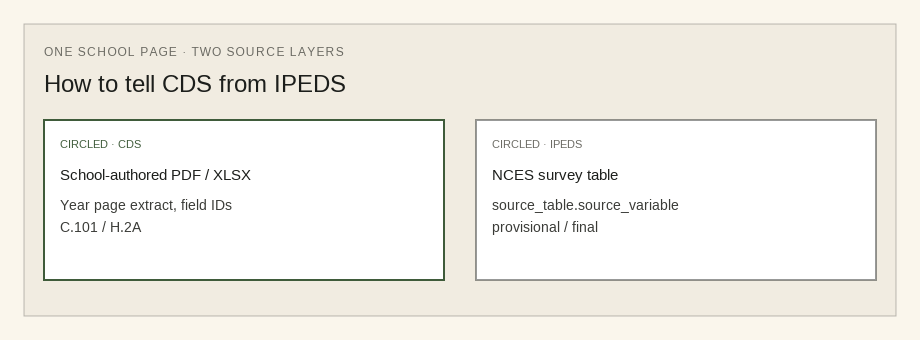
Each school page keeps its sources visually separate. Common Data Set figures live in the main school-year view alongside the downloadable original file. IPEDS figures appear in the federal baseline table with their UNITID, table, and variable names. College Scorecard outcomes sit in their own section with cohort vintage notes.
Related: What is the Common Data Set · College Scorecard, and how it differs from the Common Data Set.