Last reviewed August 17, 2026
College Scorecard, and why it is not a CDS
The federal consumer tool answers cost, debt, and earnings questions the Common Data Set never did. It is not this year’s admit table, and we do not blend the two into one unlabeled number.
Origin
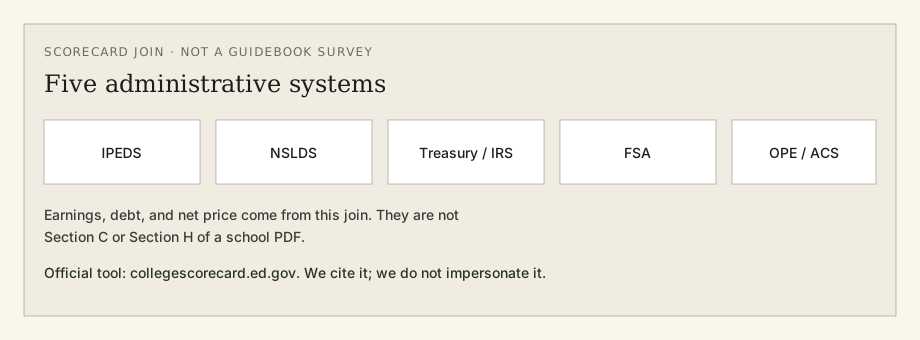
The Obama-era College Scorecard is a Department of Education consumer-information product. It was not designed as a guidebook survey. Schools do not fill it in the way they fill a Common Data Set. Administrative systems already hold the records; Scorecard publishes a join of those records for prospective students.
The official site at collegescorecard.ed.gov is the navigational result for “college scorecard.” This page is not trying to replace that. It exists so a reader of a school page here can see why a Scorecard earnings figure sits next to a CDS admit rate without becoming the same number.
What it actually is now
Current Scorecard institution files are a join of IPEDS, NSLDS (federal student aid), Treasury/IRS earnings, Federal Student Aid operating flags, and a handful of OPE and ACS fields. That mapping is in CDS vs College Scorecard.
| Scorecard is good at | CDS is good at | Neither |
|---|---|---|
| Net price, debt, repayment, earnings by cohort | Current-year applicants / admits / enrolled (C1) | Student-level records |
| Title IV universe (~6,000 institutions) | Wait list, ED/EA, C7 factor matrix, H2A merit | A single “latest” number that mixes vintages |
| Program-level CIP earnings on the .gov tool | School-authored PDF/XLSX you can archive and cite | Predicting admission for one applicant |
Coverage vs the Common Data Set
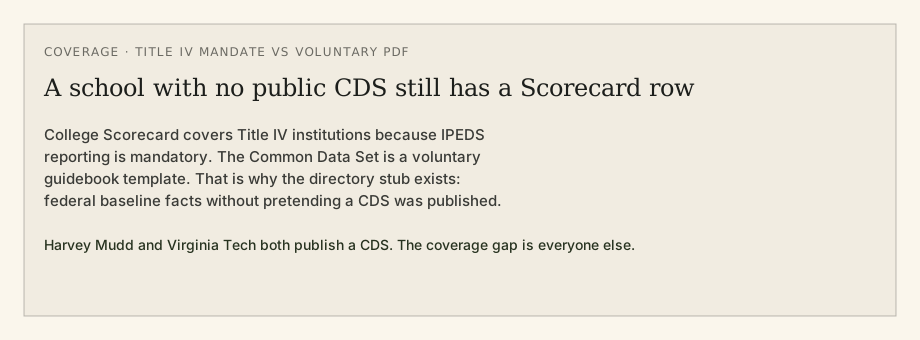
IPEDS reporting is mandatory for Title IV schools. The Common Data Set is voluntary. That is why a school with no public CDS still has a Scorecard row, and why this site’s directory stub can show federal facts without pretending a CDS exists. Harvey Mudd and Virginia Tech both publish a CDS; they are the worked examples because a reader can cross the CDS story and the IPEDS story on the same two institutions.
Lag, on a live school page
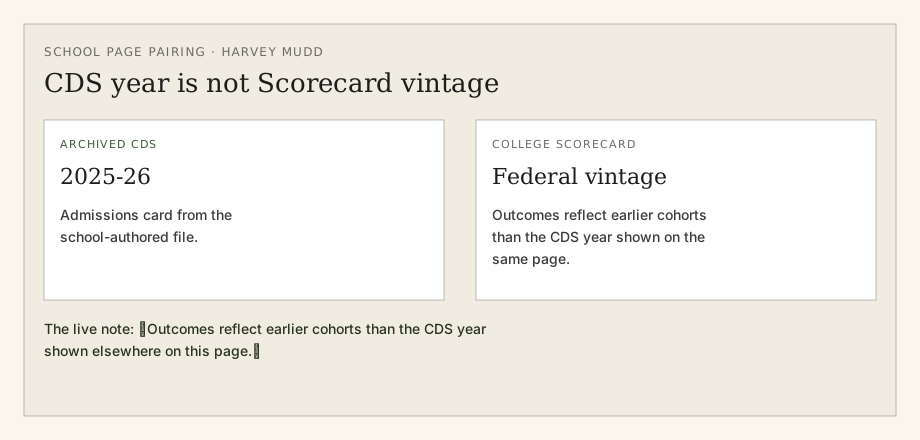
On Harvey Mudd and Virginia Tech, the admissions card is the archived CDS year. Directly under the federal outcomes band, the page already prints a vintage note: Scorecard outcomes reflect earlier cohorts than the CDS year shown elsewhere on the page. That pairing is the product. Scorecard is not “the latest CDS.”
Why it belongs next to a CDS here
Families ask for net price, debt, and earnings. Those questions are Scorecard’s job. We show them on the school page, labeled as federal, and we do not fold them into §C or §H. Virginia Tech’s 2025-26 year page is still the place for wait-list and testing extracts from the school file.
What the official site does better
Program-level CIP earnings, the comparison tool, and the full dictionary live on collegescorecard.ed.gov. We do not impersonate that site. What we do instead is keep Scorecard on the same source-linked school page as the archived CDS and the IPEDS baseline, with the vintage mismatch visible.